
Omnichannel Contact Center Architecture: Keep the Request Intact
Plan an omnichannel contact center around request identity, shared context, business records and human ownership. Use practical architecture checks.
A customer reports a missing delivery through web chat, sends a photograph by email and calls the next morning. Three teams can see three conversations. Nobody can establish whether the replacement was approved. Adding channels has made contact easier without making the underlying service request easier to finish.

An omnichannel contact center connects those interactions through an identifiable request, appropriate access and an accountable next step. The architecture should preserve useful context while recognizing that a new channel can change what the business knows about the person contacting it. A shared transcript alone cannot establish identity, permission or completion. For enterprise buyers, the important design question is whether the service can explain its current state wherever the conversation resumes.
Make the case the organizing record
Omnichannel architecture coordinates customer interactions across supported channels so service work can continue with relevant context. Multichannel availability simply offers several contact routes. The practical distinction appears when a customer changes route: can the next interaction find the right request and act on its latest state without creating contradictory work?
Use a durable case or request reference that survives individual sessions. Associate each interaction with that record only after the application establishes an appropriate relationship. A phone number, email address or device can help locate possible matches, but it should not automatically prove that two people are the same authorized customer. Ambiguous matches need a review path.
Separate interaction history from business truth. The chat may record that the customer requested a replacement. The order system may show that the replacement is awaiting warehouse review. Preserve both facts without turning the request into an approval. The next representative should see which statements came from the customer, which facts came from a business system and what remains undecided.
Divide the architecture into operating responsibilities
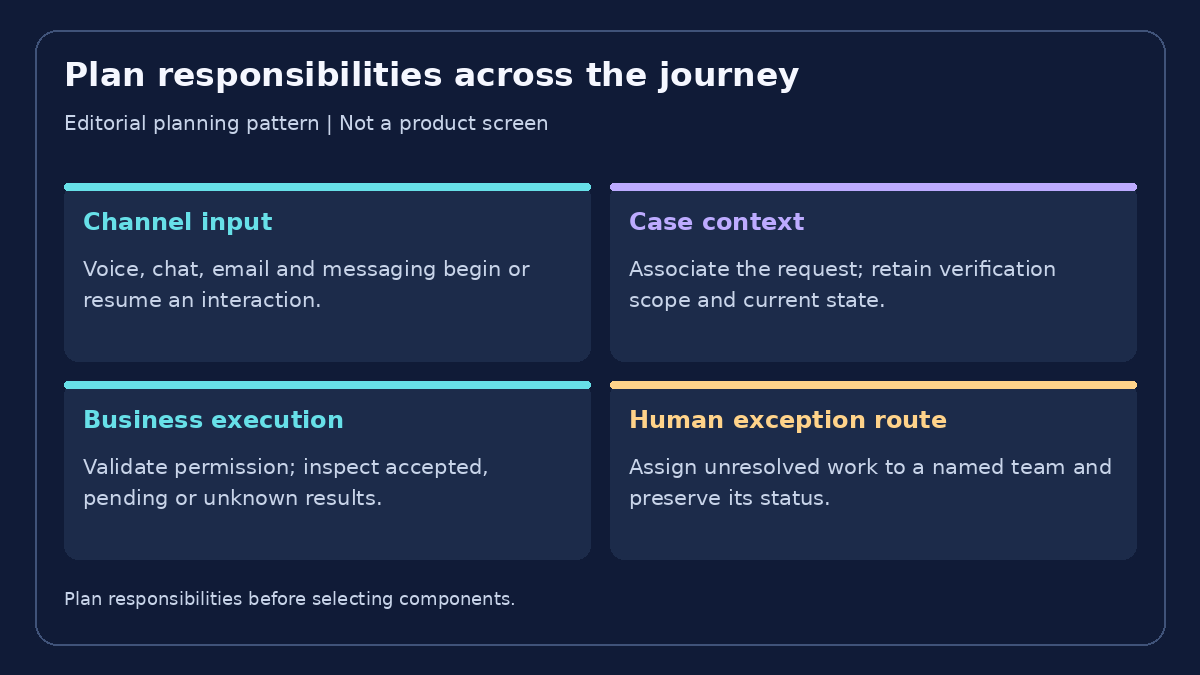
Start with channel adapters that receive voice, chat, email or messaging activity. Behind them, define identity checks, case association, workflow decisions, business-system interfaces and human work queues. These are logical responsibilities; a deployment may combine or separate their implementation. The diagram is a planning pattern rather than a description of InfoX's internal components.
Keep the responsibility for each state transition explicit. The conversational layer interprets the request, while an authorized business interface decides whether a record change is permitted and accepted. A queue receives work requiring a person. Reporting follows the complete request, including unresolved activity. Assign owners to these functions before discussing which application will host them.
InfoX's platform overview describes omnichannel engagement, knowledge, orchestration and human handoff. Use those published categories to prepare a demonstration of the proposed journey. Exact connectors, record matching, permissions and recovery behavior still need deployment-specific confirmation. Product descriptions identify areas to inspect; they do not establish that your business rules are already implemented.
Carry a compact context record between channels
The context record should explain the customer's objective, the associated request, verification status, actions attempted and outstanding decision. Include references to supporting records rather than copying every available field into every channel. A receiving employee needs a reliable account of what happened, with enough detail to inspect uncertainty.
Treat context as versioned information. When an email arrives after the customer has already spoken with a representative, its instructions may no longer reflect the current request. Compare the new message with the case state before starting another operation. Record the reason for accepting a new instruction or asking the customer to clarify it.
AWS documentation on contact chains and attributes illustrates how interaction segments can share business context within its contact model. That mechanism is a useful technical reference, not proof of identity across unrelated contacts or evidence of InfoX implementation. Design the association and authorization rules required by your own case model.
| Context field | What the next team needs |
|---|---|
| Request reference | A durable link to the service task |
| Verification scope | Checks completed and actions permitted |
| Business status | Confirmed facts and pending or unknown results |
| Next owner | Team responsible for the outstanding decision |
Recheck identity when the consequence changes
A customer may begin with a general question and later request access to protected records or a change to an order. Verification appropriate for the first question may be insufficient for the later action. Link identity decisions to the operation being requested, not merely to the fact that the conversation began in an approved channel.
When a journey moves from email to voice, decide which verification evidence can be reused and which checks must be repeated. Tell representatives what has actually been established. A summary saying "customer verified" is too vague if it omits the method, permitted scope or relevant limitations. Avoid carrying passwords or unnecessary sensitive data as conversational context.
Apply access restrictions to the receiving role as well as the customer. A specialist may need information that a general queue should not receive. Route the minimum useful record to the correct team and retain controlled references to additional evidence. Context continuity should not become a reason to disclose every detail to every participant.
Handle concurrent activity without competing promises
In the missing-delivery illustration, a customer could call while the email team investigates the same case. Define how the workflow detects an operation already pending. A second interaction should retrieve its state before creating another replacement or refund request. Otherwise, channel continuity can conceal duplicate work rather than prevent it.
Business interfaces should return a result that distinguishes accepted, rejected, pending and unknown outcomes. A timeout after submission may leave the result uncertain. Preserve an operation reference and check the authoritative record before repeating the action. Do not infer failure solely because the conversational application did not receive a response.
Make the customer message match that state. If warehouse approval is outstanding, explain that the request remains under review and provide a follow-up route. If a change is rejected, explain the available options within policy. Different channels may express the message differently, but they should not communicate incompatible promises about the same request.
Design asynchronous work as unfinished service
An email exchange can pause for hours while a live call expects an immediate response. Define what happens when a customer leaves, when a queue is closed and when another team must act later. The case needs a next owner and a visible status even when no conversation is currently active. Silence should not silently become resolution. Keep the outstanding request visible until an accountable decision changes its status.
Test continuity at the failure boundaries
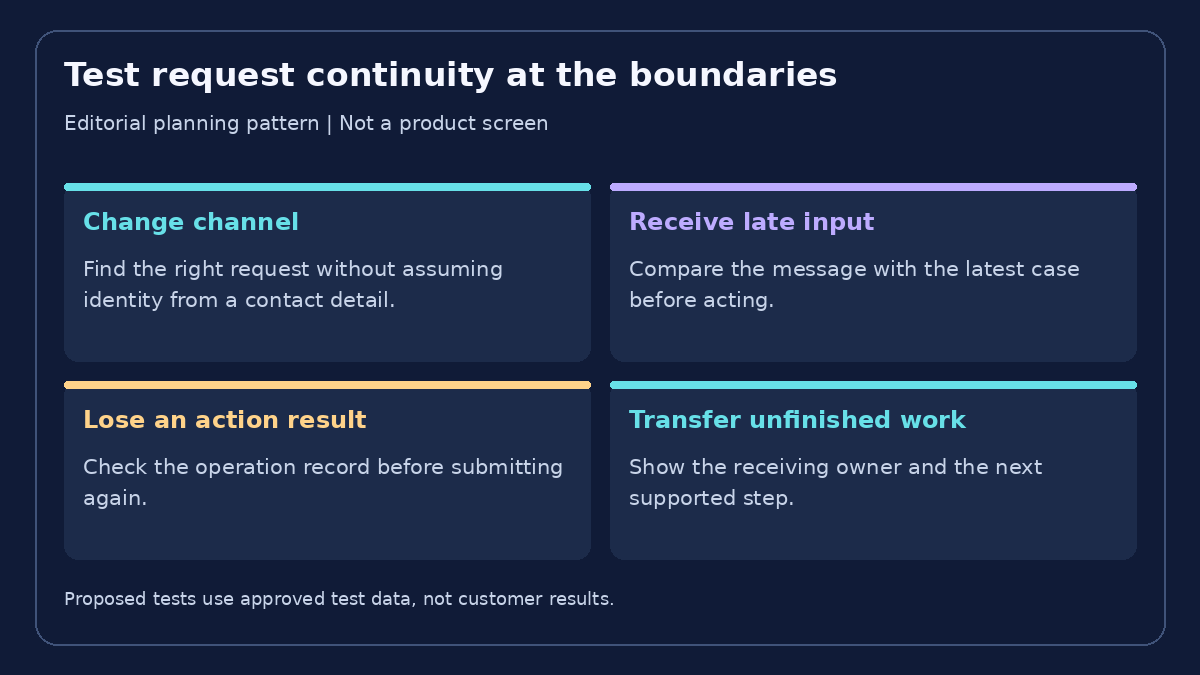
Testing each channel independently will miss many cross-channel defects. Follow one request through a channel change, a delayed message, an uncertain business operation and a human transfer. Inspect the underlying case and business record alongside the customer-facing response. A demonstration should show the resulting state, not only a fluent summary of the conversation.
Use permitted test data and deliberately ambiguous matches. Include two people sharing a contact detail, an outdated instruction and a customer whose access changes during the journey. Verify that the workflow asks for clarification or limits the action appropriately. These are proposed acceptance tests; they are not claims about a product's current behavior.
| Test case | Evidence to inspect |
|---|---|
| Ambiguous customer match | Clarification or restricted action, not automatic merging |
| Delayed instruction | Latest case state and reason for accepting an update |
| Uncertain action result | Operation reference and authoritative status check |
| Unavailable specialist | Visible fallback and accountable ownership |
Give the operating team a usable view
The service review should reveal requests waiting for association, verification, a business result or human ownership. Track duplicate operations, repeated explanations and cases reopened after an apparent resolution. Count complete requests separately from individual contacts so a growing number of messages is not mistaken for a growing number of resolved issues.
Assign ownership for the context schema, routing rules and integration failures. Changes to a business interface or a channel's supported fields can alter the information reaching a representative. Keep a version record and rerun the affected continuity tests. A journey approved against an earlier configuration should not become permanent evidence for changes nobody has assessed.
Keep routing changes separate from case changes
Moving a conversation between queues should not silently change the underlying business request. In the delivery illustration, a transfer to a specialist does not itself authorize a replacement or close the investigation. Record the routing event separately from any business decision. This allows reviewers to distinguish a customer reaching the right team from that team completing its work.
Agree on a fallback when a case reference cannot be recovered. The representative may need to locate the request using approved checks or create a clearly identified investigation task. Avoid automatically combining ambiguous histories merely to make the interface appear continuous. A visible uncertainty is easier to resolve than a confident association with the wrong person's record.
For the wider platform decision, use the InfoX enterprise AI contact center guide. For channel-specific detail, read the guide to AI voice agents for contact centers. Those articles address the overall buying process and live speech respectively; the design here focuses on preserving request state across boundaries. Keep those editorial scopes distinct when planning internal navigation.
Use sources to distinguish capability from deployment proof
The AWS contact model explains a mechanism for preserving interaction context. InfoX's published platform categories identify relevant product evaluation areas. Neither source establishes your case-matching policy, identity assurance, business acceptance rules or queue ownership. Those decisions require an approved design and test evidence. Keep this boundary visible when comparing suppliers so a supported channel is not confused with a completed service journey.
Start with one request that crosses one boundary
Choose a representative request that changes channel or team, then define the context, authority and next owner at that boundary. Resolve the mismatches before expanding the journey. A useful architecture lets the next participant continue the work while understanding what the previous participant could not confirm.
Explore Omnichannel CX with InfoX using one request, its channel changes and the business records that establish completion. Ask for the routine path and the unresolved states to be demonstrated together.

Frequently asked questions
Ready to evaluate an enterprise AI contact center?
Explore hands-on demonstrations, review reference architectures, and define measurable operational acceptance criteria with our CX engineering team.