
How AI Voice Agents Work in Contact Centers
Learn how AI voice agents handle live calls, business actions, interruptions, and human handoff, with practical tests for enterprise contact-center buyers.
A caller asks to change an appointment, pauses to find a reference number, and corrects the date halfway through the reply. The voice agent must keep the conversation coherent while checking availability and avoiding an unauthorized change. A convincing voice is only one part of that task. The system also needs to know what the caller actually said, which operation is permitted, whether the booking changed, and when a person should take over.

For buyers assessing AI voice agents for call centers, an end-to-end workflow is more useful than a model demonstration alone. This guide explains how live audio, conversation handling, business tools, and human transfer fit together. It also sets out what to test before giving a voice agent responsibility for a customer task. The examples are illustrative, not InfoX customer deployments or measured service outcomes.
The components behind a live voice conversation
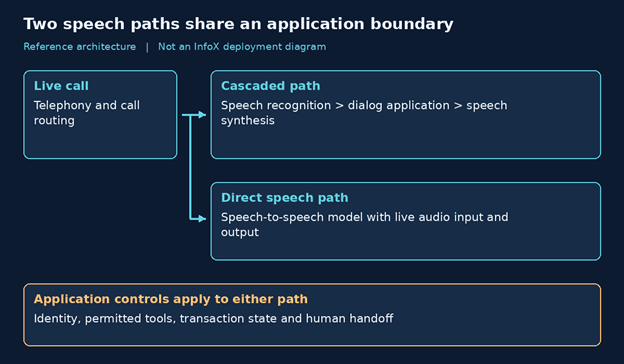
An AI voice agent receives live audio, interprets the request, obtains relevant knowledge or business data, and returns spoken responses. Application controls determine which actions it can perform. The telephony and contact center systems establish connections, direct incoming calls to the appropriate destination, and enable transfers when needed.
These responsibilities may be distributed across services, but the customer hears a single conversation and needs clear information when any component fails.
Cascaded speech processing
One architecture connects speech recognition, a language or dialog component, and speech synthesis. Recognition produces text from audio; the application uses that text to select a response or workflow; synthesis returns audio.
Twilio Conversation Relay documents a pattern in which it handles speech recognition and speech output while an application supplies responses through a WebSocket connection. This is an example architecture, not a claim that InfoX uses Twilio.
Direct speech-to-speech models
Another architecture accepts audio and generates audio through a speech-to-speech model. AWS documents Amazon Nova 2 Sonic with bidirectional streaming, turn-taking, interruption handling, and tool support.
Its guide also states an eight-minute connection limit and points to renewal and session-continuation patterns. A connection limit is not necessarily the permitted length of a customer call; the application must handle continuation correctly. Confirm the exact model version, Region, and integration in the proposed deployment.
Neither architecture removes the need for business logic. A model can interpret a request or propose a tool call, but the application must validate permission and parameters before an operation changes a record. Choose the speech design according to channel requirements, languages, operational visibility, and application constraints. Do not assume that a direct speech model automatically supplies customer authentication, approved workflows, or a complete contact-center operating model.
Follow the request from audio to a business result
The call starts with the channel connection and the organization's approved greeting and disclosures. The application then needs enough information to identify the task. If the caller asks a general policy question, approved knowledge may be sufficient. If the request involves account information or a transaction, establish the required identity and authorization before retrieving or changing restricted data. Recognizing a voice or a familiar name is not, by itself, permission to perform an account action.
The conversation layer should collect missing information one step at a time. For an appointment change, distinguish the existing booking from the requested replacement. Read back important dates and identifiers in a form that the caller can understand. If an identifier remains ambiguous, use an approved alternative verification or input method rather than repeatedly guessing. The business system should reject invalid values even when the generated conversation appears confident.
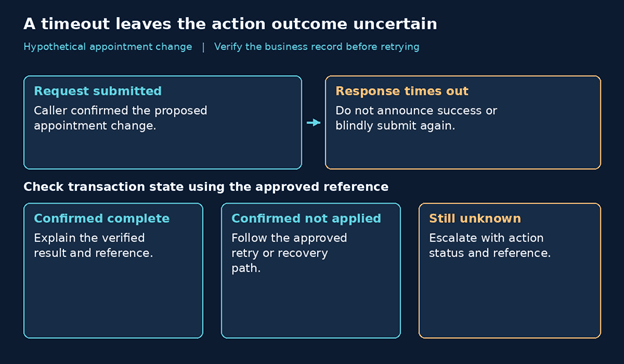
When the caller confirms an eligible change, the application submits a permitted operation and checks the result. The agent should distinguish a request that has been received from a change that has been completed. A successful response from the booking service may provide the new record state or a reference. If the operation times out, the application needs to determine whether it committed before retrying, so the same request does not create duplicate work.
Operational Responsibilities and Inspection Evidence
| Stage | Responsibility | Evidence to inspect |
|---|---|---|
| Understand | Interpret speech and clarify the task | Correct dates, identifiers, and mid-turn corrections |
| Authorize | Validate identity, permissions, and parameters | Rejected out-of-scope requests and bounded authorization |
| Execute | Submit the permitted business operation | Known transaction state and deterministic duplicate handling |
| Respond or transfer | Explain the verified result or route to a person | Delivered speech and received handoff context with status |
Turn-taking and interruptions change the design
People pause, speak over each other, restart sentences, and correct earlier answers. The agent needs to distinguish a thinking pause from a completed turn and a meaningful interruption from background sound. Microsoft Foundry's voice-agent guidance recommends testing short responses, hesitant speech, noise, accents, and interruptions at different points in a reply. Treat those tests as part of service acceptance rather than polishing the voice only after the transaction path works.
A stopped response also creates a state problem. The model may have generated a full confirmation even though the caller heard only its opening words. Twilio's Conversation Relay WebSocket documentation includes an interruption event with the spoken utterance up to the interruption. Designs should use the relevant provider's playback and interruption information to keep conversation history consistent with what was actually delivered. Do not treat every generated sentence as a statement the customer heard or accepted.
An interruption cannot be assumed to cancel a business transaction. The audio playback, model generation, and tool operation may have different states. If the caller says stop while a change is underway, the application must check whether the operation is pending, completed, or reversible. The next reply should explain that verified state. A new utterance should not silently undo an action, submit it again, or imply that cancellation succeeded without confirmation.
A hypothetical appointment call with an uncertain result
Consider a hypothetical service organization accepting appointment changes. After the required verification, the caller requests Tuesday afternoon. The agent obtains available slots, offers one, and repeats the date for confirmation. The caller then says Wednesday instead. Before submitting a change, the application replaces the proposed slot and obtains a fresh confirmation. This example illustrates controlled conversation state; it does not imply that a particular scheduling connector is included in InfoX.
Now suppose the booking request times out after submission. The agent should not say that Wednesday is booked simply because the intended action was clear. The application checks the booking state using its approved transaction reference. If it cannot establish the outcome, it should explain that confirmation is pending and follow an approved escalation path. A receiving employee needs the request, verification status, attempted action, and known result, not just a positive-sounding conversation summary.
Design handoff as a working service path
Define which requests require human judgment and how callers can ask for a person. The handoff design must specify the receiving queue, transferable context, availability checks, and behavior when nobody can answer. The agent should communicate what is happening without promising a successful transfer until the downstream system confirms it. If the business offers a callback or another route, confirm that the promised follow-up was actually created.
Pass only the information the receiving team needs and is permitted to access. Include the caller's stated purpose, relevant verified details, unresolved questions, and the status of attempted operations. Keep sensitive information out of unnecessary summaries. Recording, transcript retention, disclosure, and access policies should be approved for the intended deployment and jurisdictions. Do not infer regulatory compliance from a model's capabilities or from a general product feature list.
Measure the complete call rather than one response
Track responsiveness from the caller's completed turn to audible output, then separate channel, model, and tool delays where instrumentation permits. A brief acknowledgment during a slow lookup can keep the caller informed, but must not imply that an action finished. Review variation and difficult calls, not just an average from a clean demonstration. Long calls should exercise session continuation and recovery, including interrupted or unavailable connections.
Measure task correctness and transfer quality alongside timing. Check misunderstood identifiers, unsupported answers, incorrect operations, repeat calls, and requests that never reached the right person. Define an eligible automated resolution before reporting it. A short call or a call that avoided transfer is not necessarily a resolved customer issue. Preserve reviewed examples so releases can be tested against the same difficult cases rather than a changing selection of favorable conversations.
Retain a shared call identifier across the conversation, tool requests, and handoff record, using the organization's approved logging policy. That connection lets reviewers distinguish a recognition error from a correct request followed by a failed business operation. Log the state transitions needed to investigate failures without copying every sensitive payload into diagnostic systems. Assign owners for the channel connection, conversation behavior, business integration, and receiving queue so an unresolved call does not circulate between teams with no accountable next action.
A source-grounded architecture decision
Twilio's documentation illustrates a cascaded application pattern, while Amazon Nova 2 Sonic documents direct conversational speech. Microsoft's voice guidance makes turn behavior, tool failures, and human transfer explicit design concerns. Use these references to identify the responsibilities your deployment must cover, not to assume one vendor's components are interchangeable with another's. Accept the design only when the spoken response, permitted action, and resulting business state remain consistent under interruption and failure.
What to inspect in an InfoX voice demonstration
InfoX's homepage describes speech-to-speech conversations powered by Amazon Nova Sonic through Amazon Bedrock. Its platform overview describes enterprise knowledge and human handoff. These are public product descriptions, not confirmation of a particular Nova model version, telephony provider, connector, or performance commitment for your deployment. Use the InfoX features page to frame the discussion, then ask the product team to demonstrate the exact configuration and relevant failure paths.
Start with a bounded customer task, include a correction and an interruption, and follow the resulting business record. Book a Demo through InfoX's verified demo page to review that scenario, including an uncertain tool result and a human transfer. The buying decision should rest on how the complete service behaves when the conversation becomes difficult, not only on how natural its first greeting sounds.
Frequently asked questions
Do all AI voice agents use separate speech recognition and synthesis?
No. Some combine recognition, dialog, and synthesis services; speech-to-speech models accept and generate audio directly. Both architectures still need application controls and call routing.
Does interrupting a voice agent cancel its business action?
Not necessarily. Stopping speech, stopping generation, and canceling a transaction are separate operations. Check the actual business state before confirming cancellation or retrying.
What should happen when a tool times out during a call?
Explain that the result is uncertain, check the transaction state, and follow the approved retry or escalation path. Do not invent a successful confirmation.
What information should accompany a human transfer?
Pass the caller's purpose, permitted verified context, unresolved questions, and attempted-action status. Verify queue availability and transfer acceptance; limit unnecessary sensitive information.
Which measures matter beyond how natural the voice sounds?
Assess task correctness, responsiveness, interruption recovery, action permissions, duplicate handling, and received handoff context. Define eligible resolution before reporting automation or containment results.
Ready to evaluate speech-to-speech AI voice agents?
Review natural turn-taking, transaction validation, and verified human handoff live on the InfoX platform.