
AI Contact Center: A Complete Enterprise Guide
Plan an AI contact center around customer tasks, trusted knowledge, action controls, human handoff, and measurable acceptance criteria before rollout.
An AI contact center should be judged by what happens to a customer's request. Can the system answer from an approved policy, complete a permitted task, and transfer the conversation when human judgment is required? A fluent response is only one part of that outcome. Enterprise buyers also need evidence that identity checks, business permissions, failure handling, and service ownership work together.

This guide provides a practical framework for evaluating those requirements. It covers the architecture behind AI-assisted and agentic service, the workflows worth testing first, the boundaries around business actions, and the measurements that determine whether a pilot is ready for wider use. The objective is a controlled service operation whose results can be inspected and explained.
What an AI contact center includes
An AI contact center uses artificial intelligence within customer service workflows to understand requests, retrieve relevant information, assist staff, or perform authorized actions. It may support voice and digital channels. Its scope includes conversation handling, business-system access, operational monitoring, and human escalation; a conversational model alone does not provide the whole operation.
Distinguish three levels of responsibility:
Assistant
Drafts recommendations or policy answers for a human service representative to review and dispatch.
Conversational Self-Service
Answers customer inquiries autonomously within strict, predefined knowledge boundaries.
Agentic Workflow
Selects and invokes permitted tools against systems of record to progress and resolve multi-step tasks.
These patterns can coexist. The right choice depends on task risk, available evidence, and the organization's ability to supervise the resulting actions.
The business case should name the problem rather than begin with a target automation percentage. Repeated order-status calls, inconsistent policy answers, and incomplete handoffs are different problems with different remedies. Establish the current failure modes and baseline workload before evaluating technology. A process that is unclear to experienced staff will usually remain unclear when a model participates in it.
Design around the customer task
Choose a bounded initial workflow with clear eligibility, trusted information, and a reachable human owner. An order-status inquiry may require identity verification, a lookup, an explanation, and an escalation if delivery information is inconsistent. A refund request adds financial authority and exception handling. Treat these as separate use cases even if customers describe both as a problem with an order.
For each task, define the successful outcome and the stopping conditions. State which customers and channels are eligible, which records may be accessed, which actions require confirmation, and what the system must never decide independently. Include exceptions such as an unavailable account service, conflicting policy versions, a disputed identity, or a customer asking for a person. These cases should shape the pilot from the start.
Keep the channel design practical. A voice interaction has interruption, silence, background noise, and timing constraints. A messaging thread may resume hours later, while email can include attachments and multiple requests. Shared policies do not make these interfaces interchangeable. Test the actual channel, language, device conditions, and customer population expected in deployment rather than relying only on a typed demonstration.
The architecture behind a service conversation
A useful reference architecture separates the channel interface, conversation orchestration, knowledge retrieval, identity and policy checks, business tools, and human routing. Each boundary needs an owner. Record where customer data enters, which systems receive it, and how a request becomes a business transaction. That map helps procurement and engineering ask specific questions about permissions, dependencies, and operational recovery.
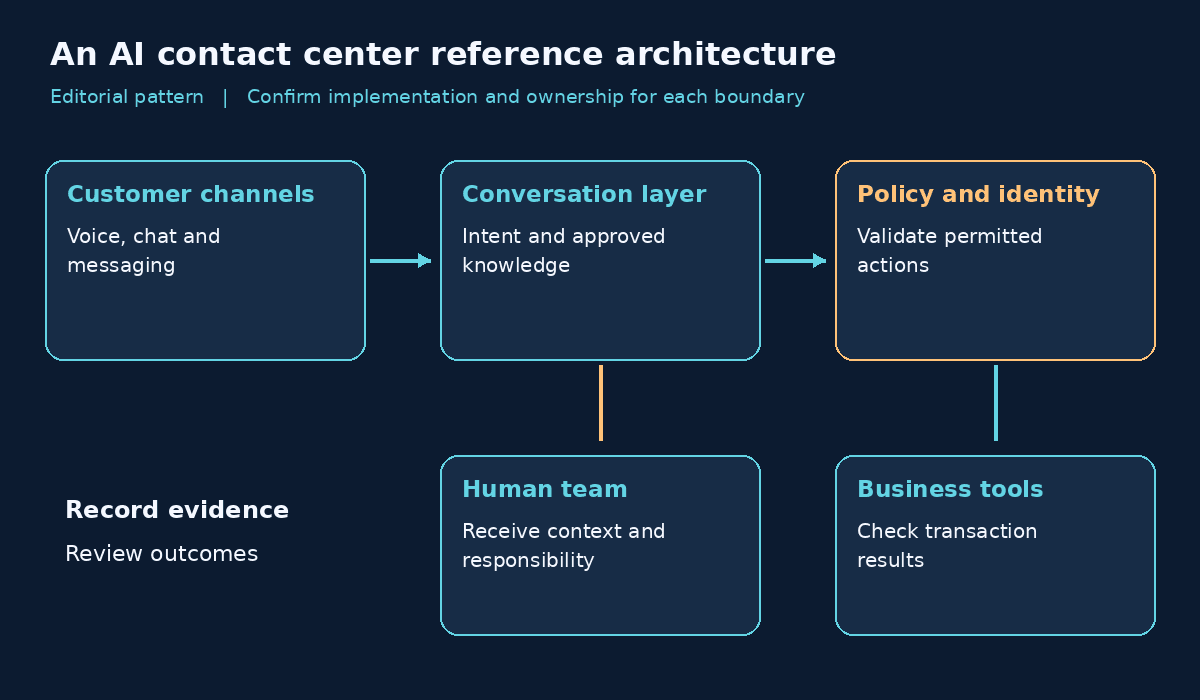
Knowledge retrieval supplies relevant material, but retrieved content is not automatically current, complete, or appropriate for the customer. Assign an owner to policy sources, approval dates, access rules, and conflicting documents. Require answers to remain within the evidence available. When the source is absent or contradictory, the service should acknowledge the limit and route the issue instead of generating a convincing policy.
Business actions belong behind explicit controls. The model may propose a tool call, but the application should validate the customer's identity, the requested operation, required fields, and authorization independently. Apply limits to transaction values and action types where relevant. Use duplicate protection and transaction records so a retry cannot silently create a second refund or appointment. These are implementation requirements, not properties established by conversational fluency.
Keep model capability separate from platform behavior
Amazon's documentation describes Amazon Nova Sonic as a speech-to-speech model with bidirectional streaming, interruption handling, and tool-use support. Those capabilities can support voice applications, but they do not establish an enterprise deployment's routing, transaction controls, or service commitments. Verify the exact model version, supported conditions, and application implementation during evaluation rather than inferring them from the underlying model name.
Make human handoff an acceptance requirement
A handoff is a transfer of responsibility, not merely a message saying someone will help. Define triggers such as customer preference, failed authentication, unavailable tools, sensitive requests, unresolved ambiguity, or repeated unsuccessful responses. Route to an accountable queue and confirm that a person or an approved follow-up process can receive the request. An escalation that disappears into an unstaffed queue has not protected the customer.
Pass a concise, accurate record: the customer's goal, verification status, relevant source references, actions attempted, confirmed outcomes, and unresolved questions. Distinguish completed transactions from proposed actions. Avoid copying unnecessary personal data into summaries. Give the receiving representative access to the supporting conversation when policy permits, and let the customer know what will happen next without promising an unapproved response time.
Triggers, Required Context, and Acceptance Checks
| Trigger | Required context | Acceptance check |
|---|---|---|
| Customer requests a person | Goal and conversation summary | Request reaches the right queue |
| Tool outcome is uncertain | Attempt ID and known transaction state | No duplicate action on retry |
| Policy evidence conflicts | Source versions and unresolved issue | Representative can inspect evidence |
| Action exceeds authority | Requested action and applicable limit | No unapproved transaction occurs |
Test a representative workflow end to end
Consider an illustrative retailer evaluating order-status assistance. A customer asks why a shipment has not arrived. The workflow verifies the customer through an approved process, retrieves the order record, and compares the available status with the delivery policy. If the carrier information conflicts with the order record, the system stops short of inventing a delivery date and transfers the issue with the evidence attached.
The pilot should also test the less convenient paths. The order service might time out after accepting a request. The customer may interrupt a voice response, switch topics, or ask for a refund that exceeds the workflow's authority. An outdated policy document might rank above the current version. Each test should specify the expected response, permitted action, evidence record, and handoff destination before it is run.
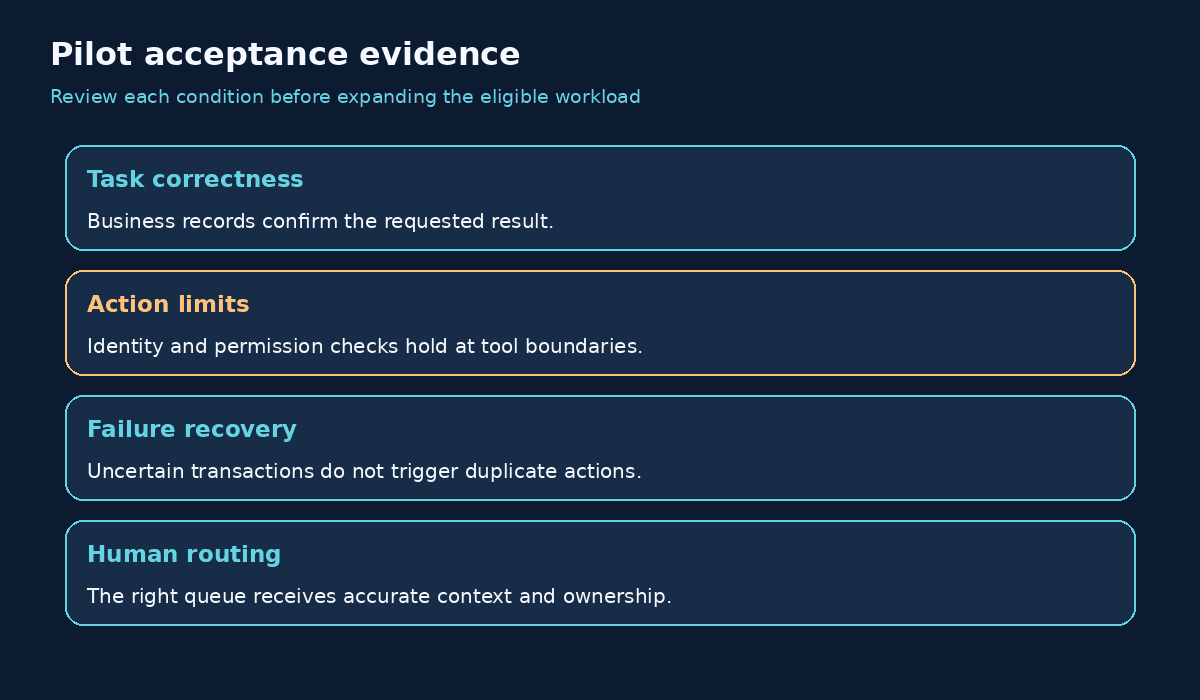
Evaluate the result at the business-system boundary. A response saying an appointment was changed is insufficient if the scheduling record remains untouched. Conversely, a tool may complete an action even when the conversation disconnects. The recovery process must reconcile the transaction and explain its status without repeating it. This is why service acceptance needs both conversation review and backend verification.
Measure quality without hiding unresolved work
Define resolution in terms of a completed customer need, with an agreed observation window for repeat contact. Measure incorrect answers, unauthorized action attempts, transfer quality, tool failures, and customer effort alongside handling time. Segment results by task, channel, language, and exception type. An overall average can hide a workflow that performs poorly for the customers who most need assistance.
Compare like with like. Record the volume and complexity of eligible requests, human review effort, infrastructure consumption, and support costs. Separate a reduction in contacts from a confirmed resolution. If a customer abandons a conversation, classify the outcome carefully rather than automatically treating it as successful self-service. Set rollout thresholds with operations and risk owners before reviewing the pilot results.
A source-grounded enterprise decision rule
Evaluate an AI contact center as an application with channels, knowledge, controlled tools, and operational ownership. Amazon Nova Sonic documentation supports claims about speech model interfaces. Amazon Bedrock Guardrails documentation describes configurable content safeguards with model and regional considerations. Neither reference proves a particular platform's compliance, transaction correctness, customer outcomes, or human staffing arrangements. Those require deployment evidence and contractual agreement.
In practical terms, use model documentation to verify an interface, a workflow test to verify an action, and an operations review to verify ongoing responsibility. Content filtering is one control; it does not replace identity checks, business authorization, or backend validation. The decision to proceed should rest on the combination of these checks rather than a vendor's broad description of autonomous service.
Where InfoX fits in an evaluation
InfoX's public product page describes an agentic contact-center platform across voice, web chat, WhatsApp, email, and SMS, built on AWS and Amazon Bedrock. Its platform page describes agent configuration, enterprise knowledge, orchestration, and context-preserving human handoff. These descriptions provide a starting point for a demonstration. Buyers should verify the required connectors, permission boundaries, channel behavior, and operating responsibilities for their own deployment.
Use the InfoX platform overview to frame the architecture discussion and its features page to prepare specific capability questions. Ask to see one representative task, one failed dependency, and one handoff from beginning to end. Request evidence appropriate to the proposed scope, including transaction records and the receiving team's view. Public descriptions alone should not substitute for that acceptance process.
Build a service operation you can inspect
A successful evaluation starts with a bounded customer task and ends with evidence that the task, its exceptions, and its ownership are understood. Keep knowledge quality, permitted actions, human routing, and business outcomes visible throughout the pilot. Expand only when the agreed acceptance criteria are met and the operating team can explain what happens when a dependency fails.
Ready to assess the fit for your customer operations? Explore InfoX to review the platform, then bring a representative service journey and its exceptions to a product discussion. Start with the decisions your customers need completed, the evidence your teams require, and the responsibilities that must remain accountable after go-live.
Frequently asked questions
How is an AI contact center different from a chatbot?
An AI contact center covers the wider service operation, including channels, knowledge, business-system access, monitoring, and escalation. A chatbot is one possible conversational interface within that operation.
Which workflow should an enterprise test first?
Choose a bounded, repeatable task with reliable source information, clear eligibility, limited action risk, and an accountable human owner. Define failure and transfer conditions before the pilot.
Does using Amazon Bedrock guarantee application compliance?
No. Compliance depends on the complete deployment, data handling, permissions, policies, contracts, and operating controls. Evaluate applicable requirements with the organization's responsible teams.
How should teams verify that a customer request was resolved?
Check the relevant business record, review the customer's stated need, and use an agreed repeat-contact window. Do not classify a conversation as resolved solely because it ended or a model reported success.
What should buyers ask InfoX to demonstrate?
Request a representative task, an unavailable dependency, and a human handoff, with evidence of the resulting business records and receiving queue. Confirm the exact deployment scope and responsibilities.
Ready to modernize your contact center operations?
Experience autonomous agentic workflows with low-latency Amazon Nova Sonic voice intelligence and Bedrock guardrails.