
Contact Center Automation ROI: Build a Defensible Business Case
Measure contact center automation ROI with a task-level baseline, attributable benefits, full operating costs and clear distinctions between capacity and cash.
A finance director receives a proposal promising fewer agent hours. The operations director sees a different future: people will still handle exceptions, review incorrect answers and maintain the knowledge base. Both may be describing the same deployment. The investment decision depends on which work actually disappears, which work moves elsewhere and which costs remain on the budget.

Contact center automation ROI compares attributable economic benefits with the full cost of introducing and operating automation over a defined period. It is not the percentage of conversations that avoid an agent. A defensible business case connects a verified customer outcome to an observed change in work and an approved financial treatment. Start there before assigning a dollar value to a dashboard.
Define the unit of value before collecting activity
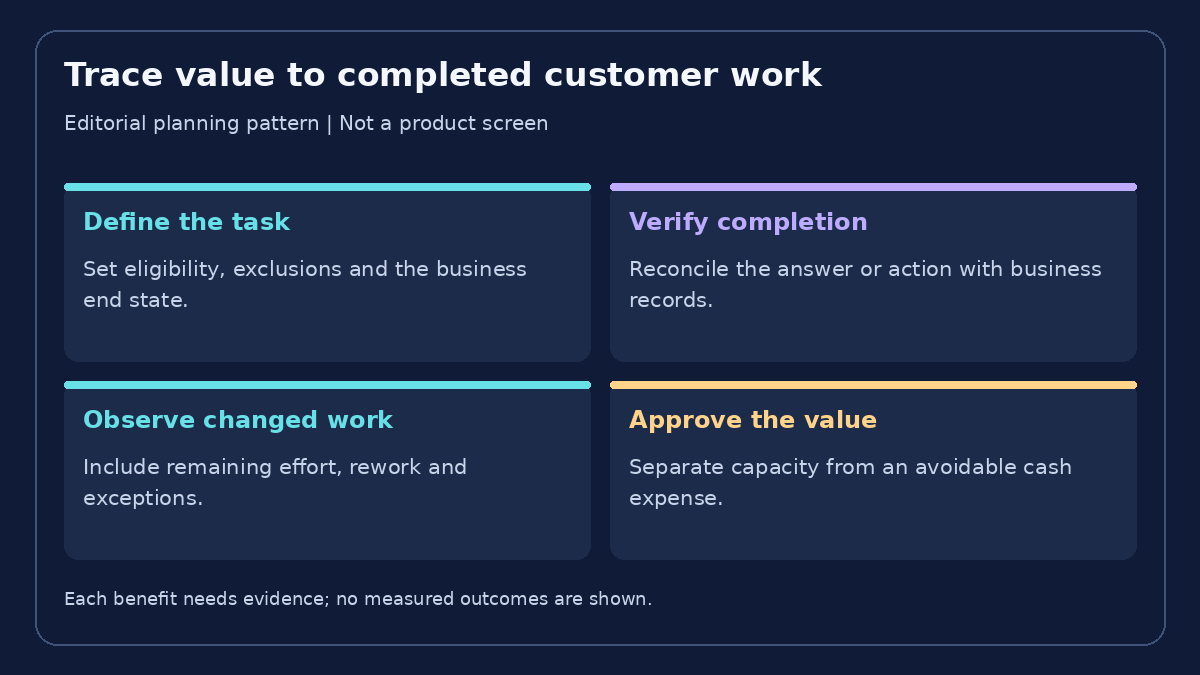
Choose a service task with an observable end state, such as answering a billing-status inquiry from an authoritative account record. Define the eligible population, exclusions and evidence of completion. A session ending without transfer is insufficient evidence if the customer abandoned it or contacted another channel to finish the request. Use a request identifier wherever possible to connect those events.
Keep attempted automation, correct completion and economic benefit as separate measures. An assistant may handle a conversation but provide the wrong account status. It may answer correctly while leaving the same amount of human follow-up. It may release staff time without changing paid staffing. Each outcome answers a different question and needs a different evidence trail.
For an informational workflow, specify how reviewers will judge the answer and its relevance to the actual request. For a transactional workflow, use the confirmed business result. Record failures and exclusions rather than removing them after measurement. Otherwise, a supplier can appear successful merely because difficult requests disappear from the denominator.
Establish a baseline that can survive comparison
Measure current work across the entire task, including transfers, research, after-contact documentation and later corrections. Record the observation window and the systems supplying each field. The baseline should represent the operating conditions the proposed workflow will face, rather than a convenient period with unusually simple requests or unusually experienced staff.
Segment the population where differences matter. Language, channel, task complexity and customer eligibility can affect both effort and completion. Compare like requests, and disclose remaining differences. A billing-status workflow handling only straightforward accounts should not be evaluated against the average cost of all billing complaints. The latter includes work the automated path was never intended to perform.
Where feasible, retain a comparable reference group during the pilot. If allocation is not randomized, document selection rules and plausible sources of bias. Policy changes, staffing changes and seasonal demand can alter results independently of automation. Avoid presenting every movement in a before-and-after chart as a causal effect of the new system.
Distinguish released capacity from cash savings
Time returned to employees is capacity. It becomes a financial benefit only through a credible operating decision: avoiding a planned hire, reducing paid overtime or assigning that time to valuable work. Name the decision owner and the conditions required. A spreadsheet multiplying minutes by salary does not itself establish an avoidable expense.
Keep cash savings and capacity value in separate columns. A team may use available time to reduce a backlog while retaining the same payroll. That can support the investment, but it should not be presented as a payroll reduction. If the backlog benefit cannot be valued reliably, report the operational improvement without forcing it into the financial total.
Check for double counting. If reduced handling time contributes to an approved staffing change, do not also add the same minutes as independent productivity value. Likewise, a repeat contact avoided should not be counted again as a separate removed task if its labor is already included in the task-cost baseline. Trace each benefit to its underlying work.
| Observed change | Financial treatment |
|---|---|
| Less manual handling | Capacity until an approved operating decision assigns value |
| Avoided paid overtime | Cash benefit only when attributable and documented |
| Backlog reduction | Operational benefit; value separately if defensible |
| Fewer repeat contacts | Count effort once within the task-cost comparison |
Include the work that keeps automation useful
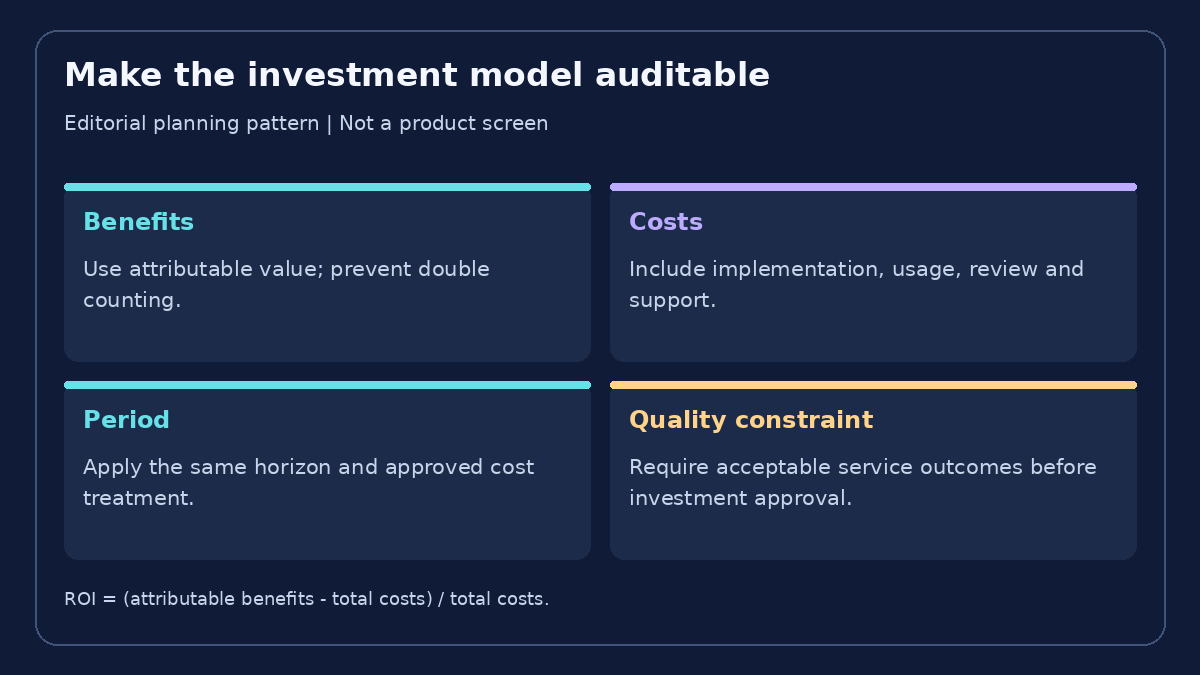
The cost ledger should include implementation, integrations, testing, platform and usage charges, internal supervision, knowledge maintenance and exception handling. Separate one-time expenditure from recurring operation. Use actual commercial terms for the candidate deployment, including relevant minimum commitments and usage assumptions, rather than a generic price per automated conversation taken from an unrelated proposal.
Account for the human work created by the system. Someone must inspect disputed answers, update policies, review unsuccessful actions and maintain reporting definitions. Determine which team supplies that work and whether it needs additional budget. Moving effort from frontline agents to an engineering or quality team changes its location; it does not make the effort free.
Include transition costs when the old and new workflows run together. Training, parallel operation and controlled testing can affect the first period differently from later periods. State whether the model includes those costs and how it treats capital expenditure. Ask finance to approve the method before comparing proposals that use different accounting assumptions.
Calculate ROI on an explicit time horizon
For a defined period, ROI equals attributable benefits minus total costs, divided by total costs. Express the result as a percentage only when the inputs support that precision. The period must be identical for costs and benefits. Include all deployment costs assigned to that period and explain any amortization or discounting convention approved by finance.
Payback asks when cumulative attributable benefits cover cumulative costs. It answers a different question from ROI. A workflow might have a positive expected return over a longer period while failing the company's permitted payback window. Show both only when the monthly timing is defensible; do not imply that benefits start at full strength on the launch date.
Use scenarios for uncertain adoption, eligible demand, human review and usage charges. Change the assumptions most likely to alter the decision rather than adding arbitrary optimistic and pessimistic percentages. If a small change in recurring review effort reverses the conclusion, that uncertainty deserves a pilot measurement before a larger commitment.
| Input | Evidence and owner |
|---|---|
| Eligible demand | Request population and exclusions; service owner |
| Attributable benefit | Changed work and approved valuation; operations and finance |
| Total cost | One-time and recurring ledger; finance and technology |
| Quality limits | Review method and acceptance criteria; service quality owner |
| Uncertainty | Assumptions, scenarios and review date; investment owner |
Measure the pilot without rewarding unfinished work
Track eligible requests, verified completions, repeat contacts and remaining human effort together. Choose the repeat-contact observation window according to the task and disclose it. An apparent resolution can be reversed by a later correction. Review unresolved cases after the pilot ends so the measurement period does not artificially exclude their downstream workload.
Use customer and quality measures as decision constraints. Faster handling is not acceptable if incorrect actions, complaints or unnecessary disclosures increase beyond approved limits. Establish the review method and acceptance criteria before testing. A favorable cost estimate should not override a failed quality requirement simply because the dashboard combines several measures into one score.
AWS's contact-center metric definitions illustrate why metric names need operational definitions. Contact handling and agent-connected activity are not interchangeable with a completed customer task. If a reporting system provides those measures, document their scope and reconcile them with business records. This reference describes AWS reporting, not an InfoX analytics configuration.
Build a citation unit the investment committee can inspect
Separate evidence into product scope, operational measurement and financial approval. InfoX's features page describes analytics and operational capabilities for evaluation. AWS documentation explains specific contact metrics. Neither supplies your baseline, staffing decision, negotiated charges or attributable return. The business case needs enterprise records and finance approval for those inputs.
Retain the dataset version, calculation rules, exclusions and review decisions supporting each reported result. When an assumption changes, update the model and explain its effect. This makes a later investment review possible without depending on a presentation whose numbers cannot be reconstructed. The objective is an auditable decision, not a persuasive percentage detached from service operations.
Turn the model into a focused vendor discussion
Assign an owner to each assumption
The service owner should approve task eligibility and completion rules. Workforce planning should explain whether released time changes staffing requirements. Technology owners should confirm integration and support effort. Finance should approve the valuation and period. A named owner does not make an estimate certain, but it identifies who must supply evidence when a decision rests on that estimate.
Record which assumptions are contractual, observed or provisional. Usage charges may be contractual while expected adoption remains provisional. Pilot handling effort may be observed while a future staffing change remains conditional. Presenting all three categories with the same numerical precision can hide the risk. Show the evidence status alongside the model input so reviewers know what can change.
Set a review point after implementation. Compare actual costs and service outcomes with the approved model, including the assumptions that proved wrong. Adjust the operating plan rather than preserving a return forecast that no longer matches the work. This closes the business-case loop and gives the next investment decision a more useful baseline than the original sales proposal.
Ask the provider to identify the records available for completed tasks, exceptions, usage and human intervention. Bring your proposed definitions to the demonstration. Verify whether the required data can be obtained and reconciled in the intended deployment. Published analytics categories are a starting point for that discussion, not evidence that every required export or calculation is already supplied.
For a broader use-case assessment, the InfoX guide to contact center automation provides related workflow context. Keep the ROI evaluation narrower: one defined task, an accountable cost ledger and a benefit that operations and finance recognize on the same terms. Expand the investment only after those records support the decision.
Request a Consultation with InfoX to review a candidate workflow and the evidence your business case requires. Bring the task definition, baseline and unresolved cost assumptions so the conversation can address a decision your team can verify.

Frequently asked questions
Ready to evaluate an enterprise AI contact center?
Explore hands-on demonstrations, review reference architectures, and define measurable operational acceptance criteria with our CX engineering team.