
Contact Center Automation: Use Cases and Benefits
Compare contact center automation use cases, business benefits, operating controls and pilot measures before choosing which customer workflows to automate.
A customer asks for an order update, repeats an account number, waits for a transfer, and then explains the request again. Each step might work as designed while the overall service remains slow and frustrating. Contact center automation should address that whole task, including the handoffs and business records that determine whether the customer actually received help.

Contact center automation uses rules, software workflows, and sometimes AI to perform or assist customer-service tasks. It can route requests, retrieve approved information, prepare agent work, or carry out permitted transactions. A useful deployment defines the eligible task, verifies its result, and transfers responsibility when the automated path cannot finish.
For enterprise buyers, the first decision is not which interaction to remove from the queue. It is which work can be completed correctly under known conditions. That requires a view of customer intent, operational exceptions, integration access, and the people who remain accountable. Begin by identifying the business use case, then determine the appropriate approach and supporting evidence required for approval.
Choose the mechanism that fits the task
Rules suit known conditions with stable actions, such as selecting a queue from a confirmed language preference. Workflow automation coordinates steps across systems. AI can interpret varied requests or draft answers from approved material, but an interpretation does not grant transaction authority. Keep identity checks, business permissions, and action validation outside any unsupported assumption that a fluent answer is correct.
A single customer request may use all three mechanisms. Software retrieves an order, rules determine whether it is eligible for a delivery change, and an AI assistant explains the available options. If the request needs an exception, a specialist receives the case. The design should make each boundary visible rather than presenting every action as autonomous intelligence.
Use cases with a clear operational purpose
Routing and queue management
Automated routing can match a request to relevant skills, urgency, channel capacity, and availability. Twilio TaskRouter documentation describes matching task attributes to workers through workflows and queues. The important buyer question is what happens when the preferred worker is unavailable. Define fallback queues, waiting behavior, and escalation ownership so routing does not become an indefinite holding pattern.
Information retrieval and routine status requests
Order status, appointment details, and service updates are candidates when the system can verify identity where required and retrieve authoritative records. Separate public information from account-specific information. Show the timestamp or effective date when freshness matters. If the record is unavailable or contradictory, explain the limit and offer the next supported route instead of generating an answer that merely sounds plausible.
Agent assistance and after-contact work
Automation can gather relevant case context, suggest knowledge articles, or draft a conversation summary for review. These tasks retain a human decision point while reducing repeated lookup and transcription work. The draft should distinguish customer statements from verified account facts. A supervisor also needs a way to review incorrect suggestions and ensure a copied summary does not perpetuate an earlier mistake.
Permitted business transactions
Tasks such as updating addresses, rescheduling appointments, and processing returns are suitable for automation when eligibility conditions are clearly defined and business systems permit controlled execution. Require confirmation of material details before submission. Read back the verified result afterward. For refunds, disputed identity, or policy exceptions, set limits according to the enterprise's approved procedures rather than leaving the boundary to conversational judgment.
| Use case | Potential benefit to test | Required evidence |
|---|---|---|
| Routing | Fewer avoidable transfers | Queue outcome and human acceptance |
| Status retrieval | Less manual lookup | Authoritative record and freshness |
| Agent assistance | Less documentation rework | Reviewed summary accuracy |
| Business action | Less repeated handling | Permitted action and verified result |
Design the workflow around completion and exceptions
A useful reference workflow begins with the requested task and the minimum information needed to handle it. Establish identity and permission before accessing protected records. Retrieve current policy and account context, then decide whether the action is eligible. Execute only the allowed operation, check the business record, and communicate the confirmed result or the unresolved condition.
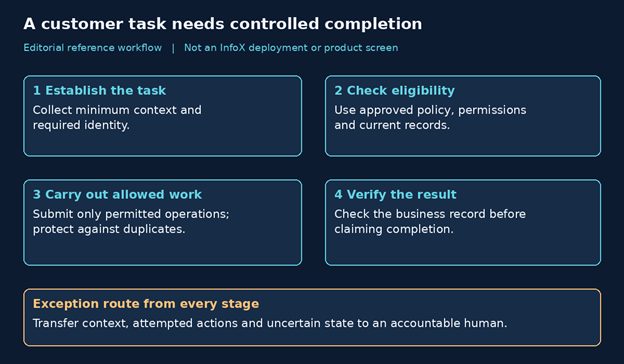
Every step needs a failure path. Missing customer details, unclear requests, outdated policies, system failures, or dropped calls require specific responses rather than a standard message indicating task completion. Preserve enough context for a person to continue, including the requested outcome, verification state, actions attempted, and whether any transaction remains uncertain. Restrict access to sensitive details during transfer.
Technical retry behavior is especially important for actions that change records. AWS documentation for the Lambda function flow block in Amazon Connect Customer describes retries for certain failures and routing through error handling. That is a reason to design duplicate protection and result verification in the application. It is not evidence that InfoX uses that block or inherits those controls automatically.
A hypothetical return request
Imagine a retailer considering automation for return initiation. In this hypothetical example, the customer provides an order reference, completes the required verification, and chooses an item. The workflow checks the actual order and current return policy. It can prepare an eligible request, while damaged-item exceptions and conflicting account details route to a specialist under the retailer's procedures.
Suppose the return service accepts the request but its response is delayed. The assistant must not treat the missing response as proof that nothing happened. The application checks the transaction reference before resubmitting. If it cannot determine the outcome, it tells the customer the request needs review and passes the uncertain state to the assigned team.
A successful handoff includes the item, relevant policy, verification state, attempted request, and known transaction status. The human should not need to repeat an action simply because the conversation changed channels. This example illustrates a design requirement, not an InfoX implementation or a measured customer result. Buyers should request that vendors demonstrate how similar failure scenarios are handled using approved test data.
Benefits should be measured at the task level
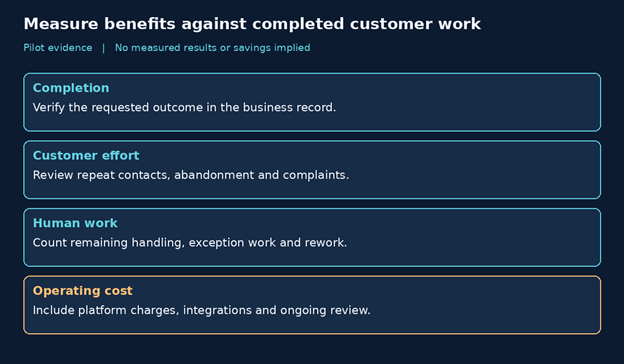
The business benefit of automation depends on what work it removes and what new work it creates. A status lookup might reduce manual retrieval. Better routing might reduce transfers. Reviewed summaries might reduce documentation effort. Those are hypotheses to test, not guaranteed savings. Count the rework, exception handling, technical support, and knowledge maintenance required to sustain the workflow.
Use verified task completion as the primary outcome for eligible requests. Define completion against the business record, not only conversation sentiment or the absence of a transfer. Track repeat contacts within an agreed observation window. Also inspect incorrect actions, reopened cases, abandonment, and complaints. A shorter contact is not beneficial if customers must return to finish the same task.
Build the cost comparison from actual work. Compare the previous handling and follow-up effort with remaining human effort, platform charges, integration support, and ongoing review. Separate one-time implementation costs from recurring operation. Avoid converting every automated minute into payroll savings; released capacity has value only when the operating plan explains how that time will be used.
Start with a bounded pilot
Select one task with a dependable source of truth and a clear exception route. Document eligible requests and explicit exclusions before testing. Assemble representative examples, including missing data, contradictory answers, tool errors, and requests that must reach a human. Keep the initial scope narrow enough that reviewers can inspect the underlying records and explain failures without guessing.
Evaluate proposed answers and actions before allowing live transactions. Then use a limited, monitored release with a responsible owner and a way to stop the automated path. Agree on acceptance criteria in advance. Set those criteria from business risk and measured baselines, rather than borrowing a vendor's percentage or treating a polished demonstration as a production benchmark.
Review changes to prompts, policies, tools, and knowledge sources as changes to the service. Repeat affected tests when those dependencies change. NIST's AI Risk Management Framework provides voluntary guidance for evaluating and managing AI risks. It does not certify a contact center or replace the enterprise's own review of access, retention, applicable obligations, and customer communications.
Test the operating conditions customers actually face
Test a request that changes channel partway through, a customer who cannot use the preferred verification method, and a case arriving after specialist hours. Define the supported alternative for each condition. Automated handling should not strand someone because the normal path is unavailable. Check that the next team receives a usable case rather than an empty transfer with a transcript attached.
Knowledge maintenance also needs an owner. When a return policy changes, identify which answers, eligibility rules, and test cases must change with it. Keep a record of the approved version used for a completed action. This makes later review possible and prevents a benefit calculation from ignoring the work required to keep the service correct. A pilot is incomplete if its operators cannot explain that maintenance process.
A source-grounded buying framework
Separate three evidence questions. Twilio TaskRouter explains task assignment and routing behavior. AWS's Lambda flow-block documentation illustrates execution and error-handling considerations. NIST's AI Risk Management Framework addresses risk evaluation and management. Together, they support asking how work is assigned, how actions are verified, and how failures are governed. They do not establish any specific InfoX integration or customer outcome.
Connect the use case to an accountable platform review
InfoX's public features page describes knowledge management, workflow orchestration, human handoff, and conversation governance. Those descriptions give buyers topics to examine, not proof that every proposed workflow is already supported in their environment. Review the InfoX platform alongside the actual systems, permissions, and service procedures the chosen task requires. Ask for a demonstration that includes a failed action and a human transfer.
Begin with a workflow whose outcome your team can verify. Name its exceptions, accountable owner, and business measure before deciding how much autonomy to permit. Explore Automation through InfoX's solutions page to compare relevant use cases, then bring one candidate task and its failure conditions to a platform discussion. The strongest proposal connects customer completion to evidence your operations team can inspect.
Frequently asked questions
Ready to evaluate an enterprise AI contact center?
Explore hands-on demonstrations, review reference architectures, and define measurable operational acceptance criteria with our CX engineering team.