
AI Human Handoff: Transfer Responsibility, Not Just the Conversation
Design AI human handoff around accepted ownership, reliable context and honest next steps. Test closed queues, uncertain actions and disconnected customers.
A customer disputes a duplicate charge. The assistant recognizes that the issue needs a billing specialist and announces a transfer. The destination queue is closed. The customer waits, repeats the complaint in another channel and receives a second case number. Recognition worked; ownership failed. That gap is the central design problem in AI human handoff.

AI human handoff is the controlled transfer of a customer request from an automated workflow to an accountable person or team, with relevant context and a clear next step. It succeeds when the receiving operation accepts responsibility under defined conditions. A message saying that someone will help is not evidence that anyone has received the work. Design the transition around that distinction.
Decide which situations require a person
Start with the reasons the automated path must stop or seek assistance. These include an explicit customer request, an action outside permitted authority, conflicting account information, an unresolved business operation or a situation requiring specialist judgment. Set the rules with service owners. A model's self-assessment should not be the only control deciding whether a consequential request continues.
Distinguish customer preference from technical failure. Someone may want a representative even when the assistant could answer the question. Another person may be willing to continue, but the application cannot verify a required fact. Those situations can use different explanations and routing priorities. Both need a supported route rather than an argument about whether the assistant is capable.
Document escalation reasons in terms operators can act on. "Low confidence" rarely tells a specialist what is missing. "Account holder disputed the transaction and the refund requires review" provides a concrete task. Use the reason to select a destination, determine what evidence is required and explain the boundary to the customer without revealing internal technical details.
Define acceptance before announcing a transfer
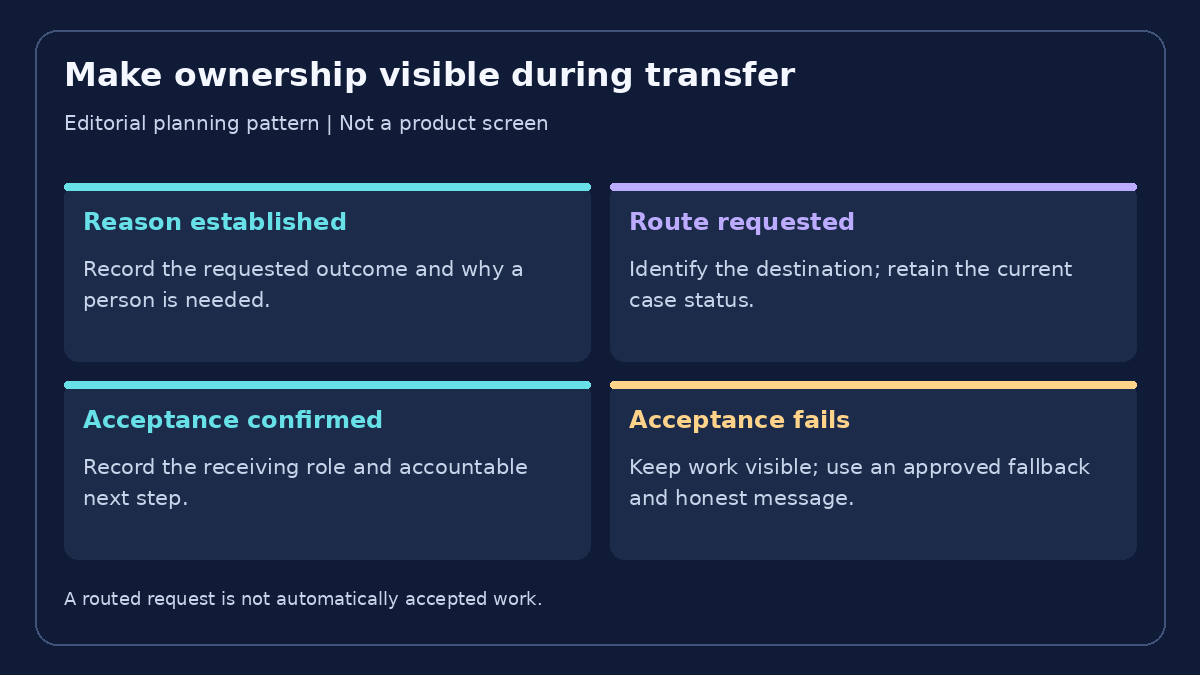
A routing request, a queued task and an employee accepting work are separate states. Define what the service can truthfully say at each one. The customer should know whether they are waiting for a live connection, have a case awaiting review or need to choose another contact option. Avoid promising an immediate conversation before capacity is confirmed.
For live service, identify the event that establishes employee acceptance. For asynchronous work, establish that the receiving team has accepted the case under an approved service process. The original workflow needs a recorded destination, status and follow-up responsibility. If acceptance fails, the request should remain visibly unassigned or awaiting recovery rather than disappearing into a successful-transfer count.
AWS documents the Transfer to queue flow block, including capacity and error paths. That is a concrete example of why routing needs explicit failure handling. It does not describe InfoX's implementation or guarantee that a person will become available. Evaluate the actual proposed deployment against your acceptance definition.
Prepare a brief a specialist can trust
The receiving person needs the customer's requested outcome, relevant record references, established verification scope, actions attempted and unresolved questions. Separate customer statements from facts retrieved from business systems. A useful handoff brief should allow the representative to continue the work while inspecting its basis. It should not require trusting an unqualified summary of everything the assistant said.
In the duplicate-charge illustration, preserve which payment entries the customer disputed, what the account record confirmed and whether a refund operation was attempted. If the result of an attempted action is unknown, make that uncertainty prominent. The specialist should check the operation reference before creating another action. A fluent summary must not turn uncertainty into an asserted failure or success.
Use controlled references for sensitive evidence and restrict the handoff to information the receiving role needs. Avoid copying credentials or unnecessary personal details into a broadly accessible queue. Where a summary is generated, retain a way to inspect the relevant source material within approved access and retention rules. Accuracy and access are separate requirements; review both.
| Brief element | Required distinction |
|---|---|
| Requested outcome | What the customer wants, separate from an approved action |
| Identity and scope | Verification completed and limitations still applying |
| Actions attempted | Operation references and confirmed or uncertain results |
| Supporting evidence | Authorized references and source of each material fact |
| Open decision | Next task and receiving responsibility |
Give the customer an honest account of the next step
Explain why the request needs a person in language relevant to the task. A billing specialist can review a disputed charge; a technical account of model uncertainty usually does not help the customer decide what to do. Say what information will be passed along and what remains unresolved. Do not say that the issue has been resolved merely because it has been escalated.
If a waiting time is unavailable, do not manufacture an estimate. Offer the approved alternatives: remain in the queue, request a callback or submit an asynchronous case where those routes are supported. State any conditions the customer needs to understand. A callback request is not a confirmed appointment unless the scheduling process actually establishes one.
Tell the receiving employee which explanation the customer has already heard. If the assistant described a refund as pending review, the next representative should not assume it was approved. Consistent messaging depends on shared status, not matching wording. Let the human correct an earlier misunderstanding explicitly rather than preserving a mistaken promise for the sake of conversational continuity.
Treat closed queues and disconnects as ordinary design cases
Check availability against the required skill, operating hours and channel before committing to a route. A general queue being open does not mean a billing specialist is available. Define what happens when the preferred destination cannot accept work. The fallback should retain the original reason for escalation so another team does not send the customer through the same unsuccessful loop.
When a customer disconnects during transfer, preserve the task according to the approved service process. Determine whether the case stays open, whether outreach is permitted and who owns it. A dropped call should not automatically erase the request or count as completion. At the same time, do not contact someone through another channel without the permissions and procedures required for that outreach.
Handle duplicate escalation attempts. A customer may retry while a case is already waiting. Associate the new interaction with existing work after appropriate checks, show its current status and avoid creating competing assignments. If the new message changes urgency or supplies new facts, make that update visible to the responsible team rather than silently replacing the earlier record.
Rehearse the handoff with the people receiving it
Test the transition using actual receiving roles and permitted test data. Ask a specialist to act from the brief without coaching from the project team. Observe whether the person can identify the next decision, inspect evidence and avoid repeating an uncertain operation. This reveals defects that a transfer animation or a transcript screenshot cannot establish.
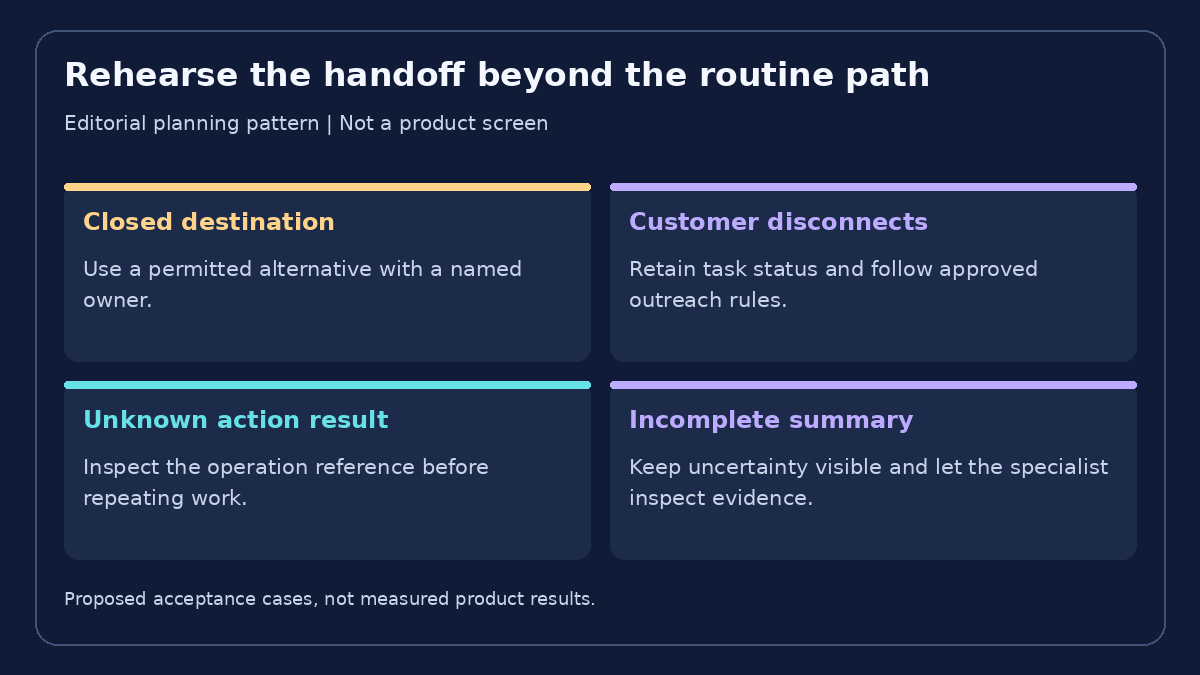
Include a full queue, a closed destination, a disconnect and a summary that omits a material qualification. Also test a customer asking for a person before providing all requested details. The workflow should retain what it knows, explain limitations and follow the approved route. Acceptance criteria should evaluate the resulting work record as well as the customer's conversation.
| Rehearsal | Acceptance evidence |
|---|---|
| Destination unavailable | Fallback case, owner and customer explanation |
| Disconnect during transfer | Retained status and permitted follow-up route |
| Unknown business result | No unverified repeat action |
| Incorrect summary | Source inspection and explicit correction |
| Customer asks for a person | Supported route and truthful availability message |
Measure accepted work and service recovery
Report escalation reasons, destination acceptance, waiting states and unresolved ownership separately. Track repeated explanations and cases that return because the receiving person lacked necessary context. A low transfer rate is not automatically beneficial: it may indicate that customers cannot reach the appropriate team. A high rate can also conceal poor routing if every transfer requires another transfer.
Review a sample of completed handoffs with frontline staff. Compare the brief, underlying evidence and eventual business outcome. When the rules change, rerun the affected tests and update training. Keep an owner for destination mappings and closed-queue behavior so staffing or process changes do not leave the automated workflow pointing at an obsolete route.
Ground the design in mechanisms and local proof
Set a boundary on automated follow-up
Once a person accepts the request, define whether the assistant may continue sending messages or proposing actions. Concurrent responses can confuse the customer and create conflicting instructions. The case should show which participant currently controls the next business step. If automated reminders remain active, their purpose and stopping conditions should be explicit to the receiving team.
The specialist may also return a task to automation after resolving the exception. Treat that as another controlled transition. Confirm the updated facts, remaining permissions and intended next action before resuming. Do not replay the original request unchanged if the person has already corrected an account record or agreed on a different outcome with the customer.
Maintain a practical escalation directory rather than a list of queue names alone. It should explain the work each destination accepts, operating conditions and approved alternative when unavailable. Review it when responsibilities change. This is an operating dependency requiring a named owner, even when the routing software itself remains unchanged. A technically valid destination can still be the wrong place for the customer's problem.
AWS's queue documentation establishes that routing can encounter explicit failure states. InfoX's platform page describes human handoff among its published capabilities. Neither establishes your staffing coverage, acceptance policy or handling of a particular disputed payment. Request deployment-specific evidence for those requirements. The source boundary matters because a product feature and an operating commitment answer different questions.
The InfoX AI contact center guide provides broader planning context. This article's narrower recommendation is to make ownership inspectable at the transition. Keep the request's current state, the receiving role and the recovery path visible. The customer should not need to restart the process because an automated workflow reached the limit of its authority.
See InfoX in Action with a handoff scenario that includes an unavailable specialist and an uncertain business action. Ask to inspect the receiving case and the fallback behavior alongside the live conversation before approving the proposed workflow.

Frequently asked questions
Ready to evaluate an enterprise AI contact center?
Explore hands-on demonstrations, review reference architectures, and define measurable operational acceptance criteria with our CX engineering team.