
AI Agents vs. Chatbots for Customer Service
Compare AI agents and chatbots by workflow, tool access, control, handoff, and evidence. Choose the right pattern for enterprise customer service tasks.
Two customer-service demonstrations can sound equally convincing while carrying very different operational responsibilities. One system explains a returns policy. Another checks an order, determines whether it is eligible, and submits an authorized return request. Both may appear inside a chat window. The buying decision is therefore not about whether the interface looks conversational; it is about which decisions the system makes and what happens after those decisions.

For enterprise teams comparing AI agents vs chatbots, the useful question is how much of a customer task should be delegated. This guide compares conversation handling, workflow control, business actions, and the evidence required to accept the result. It also explains when a rule-based flow, a knowledge-answering assistant, or a bounded agentic workflow is the more appropriate design.
Define the capability before choosing the label
A chatbot is a conversational interface that receives messages and produces responses. Its implementation may use rules, intent recognition, generative models, or a combination. An AI agent generally adds goal-directed selection of steps or tools within an application. These categories overlap: a chatbot can invoke APIs, and an agent can operate behind a chat interface.
Avoid comparisons that assign every useful capability to agents and every limitation to chatbots. A well-designed deterministic bot can complete a transaction through an integration. A generative agent can still fail to interpret a request or select an appropriate tool. Ask vendors to identify what is predefined, what the model selects, and what the application independently validates.
Amazon Lex V2 documentation, for example, describes intents, slots, and fulfillment through application logic. Amazon Bedrock Agents Classic documentation describes orchestration using available actions and knowledge sources. AWS currently states that Agents Classic is no longer open to new customers, while existing customers can continue using it. These references illustrate technical patterns, not a deployment recommendation or a universal ranking of products.
Compare three practical service patterns
A prescribed conversation with a known path
A deterministic flow works well when the eligible request and required steps are stable. It might collect an account identifier, call a permitted status endpoint, and present the returned result. The cost is maintenance when exceptions, language variation, or policy changes create many additional paths.
Do not add model-selected planning simply because an agent is available. If the business requires an exact sequence with no discretion, conventional workflow logic may be easier to justify. Natural-language understanding can still help collect information while the transaction path remains prescribed. Separating language flexibility from business authority prevents a false choice between an inflexible menu and unrestricted autonomy.
An answer grounded in approved knowledge
A knowledge-answering assistant is useful when customers ask varied questions but do not need the system to alter a record. It can retrieve relevant policy material and explain it in context. The operating burden shifts toward source ownership, version control, access boundaries, and answer evaluation. A fluent answer is not evidence that the retrieved policy is current or applicable.
Define what happens when the knowledge base is silent or contradictory. The system should identify the limit, ask an appropriate clarifying question, or transfer the request. It should not infer a new entitlement from a similar policy. For sensitive decisions, staff review may remain necessary even when the answer cites a source. Knowledge access and decision authority should be evaluated separately.
An agent that dynamically chooses from authorized actions
An agentic workflow can be appropriate when a request needs several context-dependent steps. An agent might determine which account information is missing, retrieve order details, and propose a permitted action. Its flexibility creates more possible execution paths. The application therefore needs explicit permissions, parameter validation, transaction safeguards, and stopping conditions independent of the model's explanation.
How Work Is Directed and Key Evaluation Questions
| Pattern | How work is directed | Best evaluation question |
|---|---|---|
| Prescribed flow | Defined branches and application logic | Does every required path produce the right result? |
| Knowledge assistant | Retrieval and response generation | Is the answer supported and applicable? |
| Bounded agent | Model selects among permitted steps | Are selected actions valid and independently controlled? |
Where the operational responsibility changes
The important boundary is between saying something and changing something. An answer can be checked against a policy. A business action must also be checked against identity, authorization, current system state, and transaction outcome. The more discretion a system has to select actions, the more carefully teams must test unexpected sequences rather than only the intended happy path.
Model reasoning is not an authorization mechanism. A refund tool should enforce the applicable limits even if the model supplies persuasive text explaining why a larger refund would help. Separate read access from write access, and grant only the operations required for the selected task. Customer statements and retrieved documents should not be able to rewrite the application's permission rules.
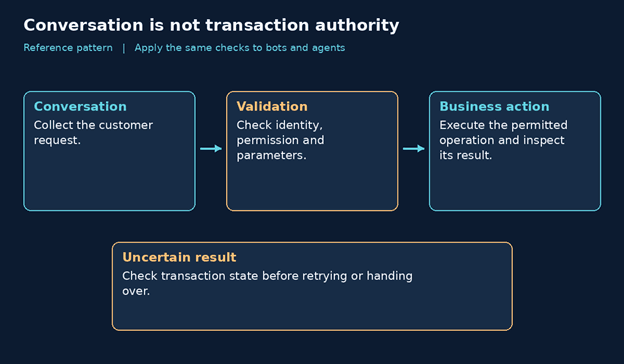
Keep the action record distinct from the conversation transcript. Record the requested operation, validated parameters, approval or confirmation where required, and the business-system response. An answer stating that a change succeeded is not a transaction receipt. If the dependency times out, the system needs a way to establish whether the action completed before any retry is attempted.
A returns request that reveals the difference
Consider a hypothetical retailer evaluating returns assistance. A customer asks whether a recently purchased item can be returned. A knowledge assistant can explain the published policy and identify the information needed to assess eligibility. A prescribed bot can collect those fields and call a fixed eligibility service. A bounded agent can select among approved lookup and action tools as the request develops.
The distinction becomes visible when the request changes. The customer may have two orders, an item outside the standard period, and a missing receipt. The business must decide which exceptions can be handled automatically and which require a person. The correct design does not depend on which system generates the most natural sentence. It depends on who is allowed to make each decision.
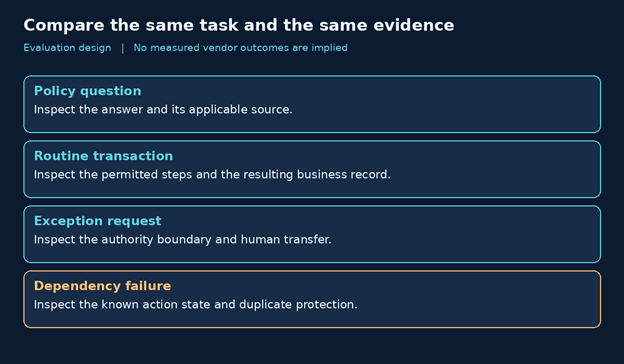
Test the same request in every candidate implementation. Inspect the source of the policy answer, the eligibility result, any customer confirmation, and the resulting return record. Next, simulate a failed lookup service and an unclear transaction outcome. This illustrative comparison tests operating behavior; it is not an InfoX customer story or a claim that one architecture will achieve a particular automation rate.
Evaluate failure paths before comparing efficiency
Build a shared evaluation set from representative service tasks and approved exceptions. Test scenarios involving ambiguous requests, contradictory information, customer-provided corrections, insufficient identity verification, unauthorized operations, and requests for human assistance. Test repeated attempts as well as isolated conversations. A system that passes a clean demonstration can behave differently after a tool error or a mid-conversation change.
Have business owners define acceptable outcomes before the trial. Score answer support, task completion, action correctness, appropriate escalation, and recoverability separately. Review a sample of failure records with the receiving service team. A transfer should preserve relevant context and distinguish completed actions from suggestions, so a human does not unknowingly repeat work or rely on an unsupported claim.
Compare total operating effort, not just time spent composing responses. Account for the effort required to maintain policies, design conversations, develop tools, conduct testing, oversee human reviews, monitor performance, and manage incidents. Agentic flexibility may reduce the need to enumerate some conversational branches, while increasing the range of paths that require evaluation. A prescribed flow may be preferable when low variation and strict sequencing outweigh flexibility.
Use identical eligibility rules across the comparison. If one candidate receives only straightforward requests while another receives disputed or incomplete cases, the resulting completion rates are not comparable. Keep a record of excluded requests and why they were excluded. Repeat the evaluation after a material policy, model, or tool change, because earlier results may no longer describe the deployed behavior. The operating team should be able to trace a measured outcome back to the task, evidence, and transaction record that produced it.
A source-grounded comparison rule
Use a prescribed workflow when the permitted sequence is fixed, a knowledge assistant when the task is primarily explanation, and bounded agentic orchestration when context determines which permitted steps are needed. Amazon Lex V2 and the existing-customer Agents Classic documentation illustrate different implementation mechanisms. The choice still depends on task variability, consequences of error, and the evidence your operating team can review.
This decision rule is an editorial framework, not an industry certification or a vendor performance benchmark. A product can combine all three patterns. Tool calling alone does not establish autonomous planning, and autonomous planning does not establish correct business execution. Verify the exact boundary between model output, application validation, and backend authority in the system being purchased.
What to verify in an InfoX demonstration
InfoX's platform overview describes agent configuration, enterprise knowledge, orchestration, and human handoff. Its public features page also describes tools and workflow integrations. These descriptions make it relevant to a capability-led evaluation, but they do not establish the exact connector, permission model, transaction behavior, or service commitment required by your organization.
Ask the product team to show which steps are prescribed, which are selected by the model, and which checks are enforced outside the conversation. Follow a representative request into the actual business record, then inspect a failed action and a transfer. Use the InfoX features page to frame the questions rather than treating a feature list as acceptance evidence.
Choose the least discretionary design that meets the need
Start with the task and its consequences. Use predefined workflows for predictable tasks, rely on verified information when answering questions, and apply agent-driven decision-making when tasks require flexible, context-dependent steps. Whatever the label, require clear ownership, observable transaction results, and a path to human judgment when the task exceeds the system's boundary.
See AI Agents in Action through the verified InfoX demo page. Bring one routine request and one exception, and ask to inspect both the conversation and the resulting system state. That discussion can establish whether the proposed design fits your service operation before you commit to a broader deployment.

Frequently asked questions
Can a chatbot complete transactions?
Yes. A chatbot can call APIs or invoke application logic. Evaluate the actual workflow and permissions rather than assuming that a conversational interface only answers questions.
Is every generative chatbot an AI agent?
No. Generating an answer does not by itself establish goal-directed selection of steps or tools. Ask which decisions the model makes and which remain prescribed.
When is a prescribed workflow preferable to an agent?
Use a prescribed workflow when the permitted sequence is stable, exceptions are bounded, and explicit control is more valuable than flexible step selection.
What should a buyer measure in a comparison trial?
Measure supported answers, verified task completion, correct actions, appropriate escalation, recovery from tool failures, and operating effort. Do not use conversation containment as a substitute for resolution.
Does an AI agent remove the need for human service teams?
No. Define human ownership for exceptions, disputed decisions, failed actions, and customer requests for a person. Verify that handoff reaches an accountable queue with accurate context.
Ready to deploy autonomous AI agents with confidence?
Evaluate goal-directed agents alongside deterministic workflows and verified knowledge retrieval on InfoX.