
How to Implement Agentic AI in Customer Service With Verifiable Results
Connect conversational judgment to authorized business actions with explicit completion receipts, bounded tools, and measurable operational outcomes.
A customer asks to change a delivery address. The assistant checks the order, repeats the new address, and says the change is complete. Behind the conversation, however, the fulfillment system has already locked the shipment. The customer hears a promise that the business cannot keep. That gap between a convincing reply and an accepted change is where implementation work deserves the most attention.

An agentic AI customer service implementation connects conversational judgment with actions in business systems. It needs a defined customer outcome, rules for who may request each change, reliable evidence of the result, and a service route for unfinished work. The model can help choose the next step; the surrounding application determines what that step is allowed to change.
For enterprise leaders, the implementation question is how to assign responsibility across those layers. Start with a service request whose result can be checked independently. Then build the permissions, exception handling, and operating procedures around that result before expanding the range of requests the agent can handle.
Write the completion receipt before building the conversation
Define what the customer should receive when the work is finished. For an address amendment, the receipt might identify the affected order, the accepted destination, and whether the shipment itself was updated or only the customer profile. Those are different changes. A general acknowledgment should never conceal which record the business actually changed.
Work backward from that receipt to the information and permissions needed. Decide which system holds the authoritative order status and which response establishes acceptance. A submitted request might still need warehouse approval. In that situation, the customer should receive a pending status and a way to follow up rather than an assertion that delivery details have changed.
Use the same definition in evaluation and reporting. Count a completed amendment only when the relevant record confirms it. Record requests awaiting approval separately. This gives operations a usable measure of work performed and prevents a polished conversation from being counted as a successful transaction when nothing has been accepted downstream.
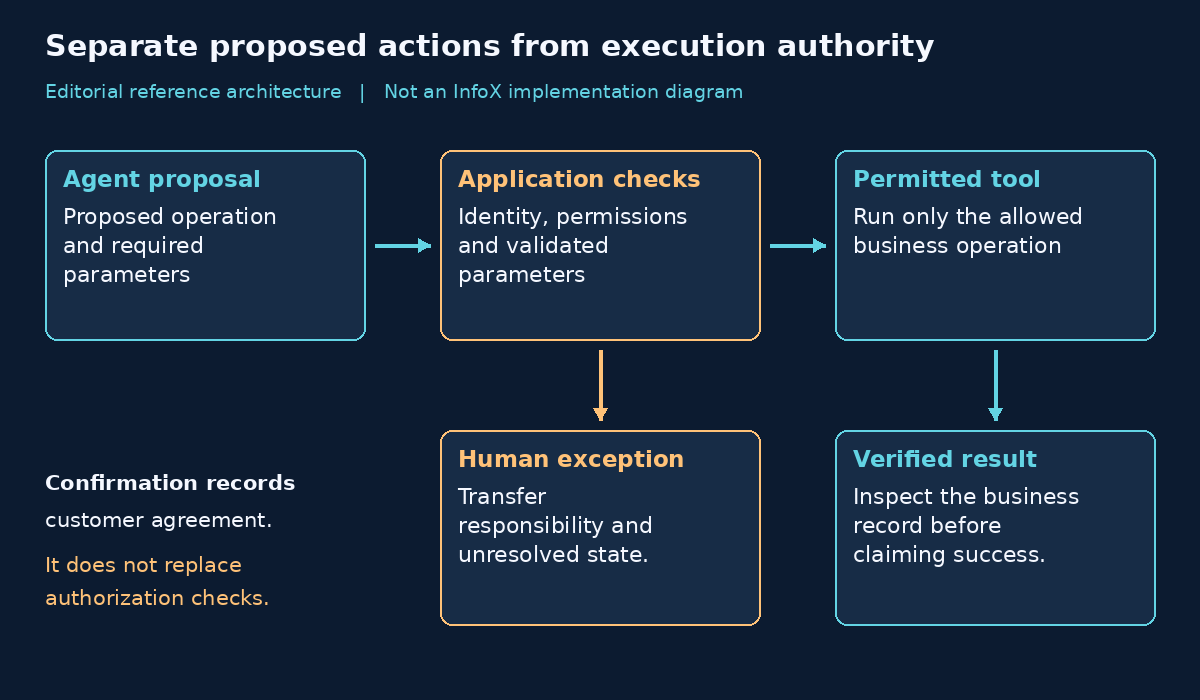
Give the application authority over each record change
Separate actions that read information from actions that modify it. Looking up shipment status and replacing its destination require different permissions. The application should check the authenticated customer, the specific order, the shipment's current state, and the requested fields. A broad credential shared across every task makes it harder to contain mistakes or explain who could change what.
Recheck eligibility immediately before execution. An order can move into dispatch while the customer is still answering questions. An earlier lookup does not establish that the requested amendment remains valid. The business interface should reject a change that no longer meets policy, and the conversation should explain the resulting options without inventing an exception.
OWASP's excessive agency guidance identifies excessive functionality, permissions, and autonomy as distinct sources of risk. Use that distinction when reviewing an integration: remove unnecessary operations, restrict the records it can touch, and decide which actions need review. Instructions in a prompt should not be the only barrier between a mistaken proposal and a business update.
Separate policy knowledge from current transaction state
A returns policy can explain eligibility, but it cannot establish whether a particular pickup has already been booked. Keep those information needs distinct. Give policy content an accountable owner and a review process. Retrieve current transaction details through an authorized interface at the point where they matter, rather than relying on a previous conversation summary.
When sources disagree, define which one controls the decision. A general article may describe standard delivery options while an order record contains a specific restriction. The agent should not combine them into a new promise. Provide a clear route for resolving conflicts, including who can approve an exception and how the customer will be informed.
Collect only the details needed for the selected request. Do not load an entire customer history merely because it is available. Decide what belongs in operational logs, who can inspect it, and when it should be removed. A reviewer needs enough information to reconstruct an action without every transcript becoming an unrestricted copy of customer records.
Treat uncertain execution as a service state
Consider a tool call that times out after submitting an address amendment. The system may have accepted the update even though the response never arrived. Repeating the call immediately could create duplicate requests or conflicting changes. Before retrying, inspect the business record or use an interface designed to recognize repeated submissions of the same operation.
Give uncertainty its own customer message and operating route. A pending verification status is more useful than either a false success statement or an instruction to start again. Preserve a reference linking the conversation to the attempted operation so the next representative can establish what happened. Set an owner and follow-up procedure for unresolved submissions.
Test cancellation as carefully as completion. If the customer withdraws agreement before execution, the application must not submit the amendment. If withdrawal happens afterward, explain that reversal may require another authorized request. These distinctions should appear in the workflow and business records, allowing reviewers to compare the customer's intent with the action that actually occurred.
Decide how a returning customer resumes an unfinished request. A new channel should not silently create another amendment while the first one is awaiting verification. Use an appropriate authenticated reference to locate the earlier request, establish its latest state, and explain the available next step. If that link cannot be established, send the case to a representative with the uncertainty recorded.
Evaluate the states that customers will encounter
Create examples that force the service into different business states. Include a record that changes during the conversation, a submitted operation with no response, and an amendment rejected by the warehouse. Review the resulting records alongside the transcript. The release decision should depend on whether each state reaches the expected outcome and responsible owner.
The following checks provide a practical starting set. Adapt them to the actual business interface and service policy before approving a pilot. They describe acceptance requirements, not measured performance or a claim that any product already implements these controls.
| Failure to test | What to establish | Release condition |
|---|---|---|
| Concurrent update | Order becomes ineligible during the chat | Reject the stale amendment |
| Unknown tool result | Submission may already exist | Verify before another submission |
| Customer withdrawal | Agreement ends before execution | Do not submit the amendment |
| Unaccepted handoff | No representative takes the request | Retain an owner and follow-up route |
Pilot one request across its full service journey
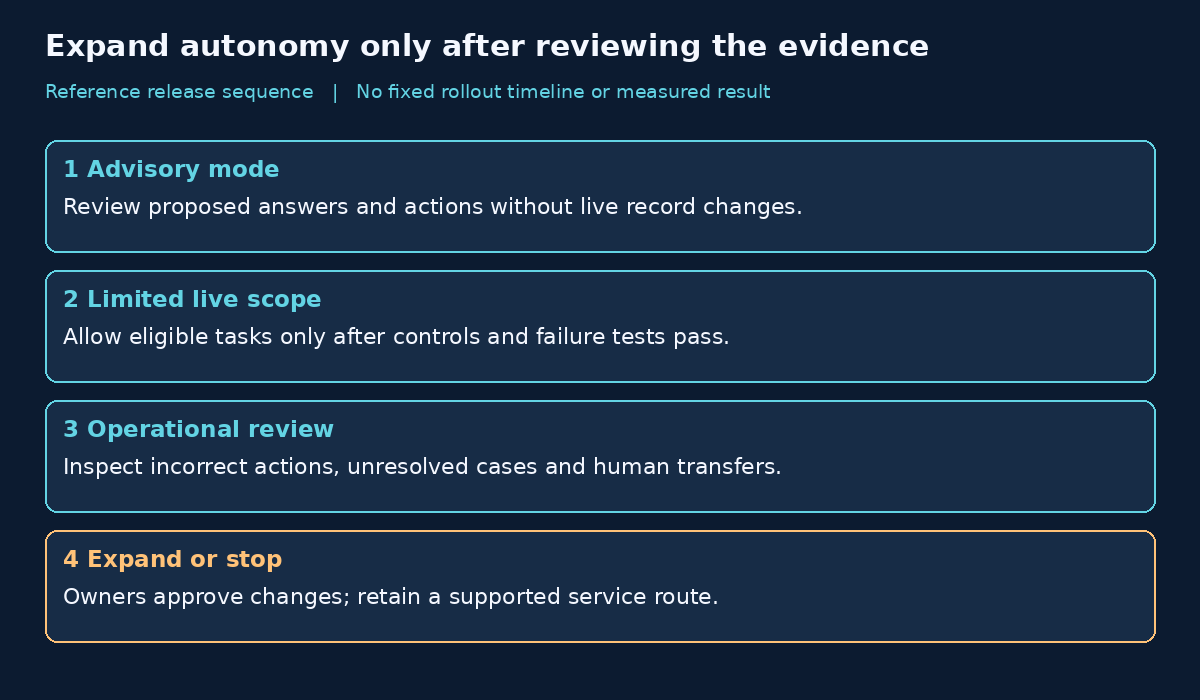
As an illustration, a retailer could begin with delivery address amendments for eligible, unshipped orders. The pilot excludes dispatched shipments and changes to unrelated account details. Representatives initially review proposed amendments and compare them with the live order. This provides concrete examples of interpretation errors without giving the agent unrestricted authority to alter customer records.
Only expand permission after the selected cases pass review. For eligible amendments, the application verifies access, checks the latest shipment state, submits the permitted change, and retrieves the accepted result. A shipment locked during the conversation moves to the designated service queue. The illustration specifies what to demonstrate; it does not describe a deployed customer project or an InfoX integration.
Choose the pilot population according to the team's ability to review exceptions. A larger population adds little learning if unresolved requests accumulate without investigation. Keep a way to suspend automated updates while preserving customer support. Review why cases failed before changing the prompt: the problem might be outdated policy, missing permissions, or an interface that cannot report a conclusive result.
Match approval design to the business consequence
Customer agreement and staff approval serve different purposes. A customer can agree to a destination while a warehouse supervisor decides whether a dispatch exception is possible. AWS guidance on human oversight distinguishes interactive confirmation from approval workflows involving separate reviewers. Select a mechanism that supports the actual decision maker, including the response when that person is unavailable.
Amazon Bedrock's return-of-control interface offers an example of passing a proposed operation and its parameters back to an application. That interface leaves room for application decisions about execution. It is a technical reference for the separation of responsibilities, not evidence of InfoX's internal architecture or proof that a particular customer policy is enforced.
Make the operating review part of implementation
Before launch, assign ownership of pending requests, incorrect changes, policy maintenance, and the tools used for execution. Review reopened cases and unresolved submissions alongside completed work. Include investigation and representative effort when assessing cost. Faster conversations may be useful, but they should be assessed against whether the promised service was delivered and whether customers needed to return. Every exception should remain traceable until someone confirms the customer's request is resolved.
Review changes after launch as changes to the service itself. Replacing a knowledge source, granting another tool permission, or updating an order interface can alter which actions become possible. Keep a version record linking those changes to the affected tests. A successful test against an earlier configuration should not become permanent approval for behavior the team has never examined.
Use InfoX's platform overview and feature descriptions to prepare a focused evaluation of agent building, business-system access, and handoff behavior. Ask the demonstration team to follow one request through an accepted update, a rejected update, and an uncertain response. Establish which responsibilities belong to the platform, your application, and the operating team before agreeing on release scope.
Start implementation with a result the customer and your team can verify. Talk to an Expert about the selected request, the records it touches, and the evidence needed to authorize its release. A clearly defined first responsibility gives the implementation team something concrete to test, operate, and improve.
Frequently asked questions
Ready to evaluate an enterprise AI contact center?
Explore hands-on demonstrations, review reference architectures, and define measurable operational acceptance criteria with our CX engineering team.